
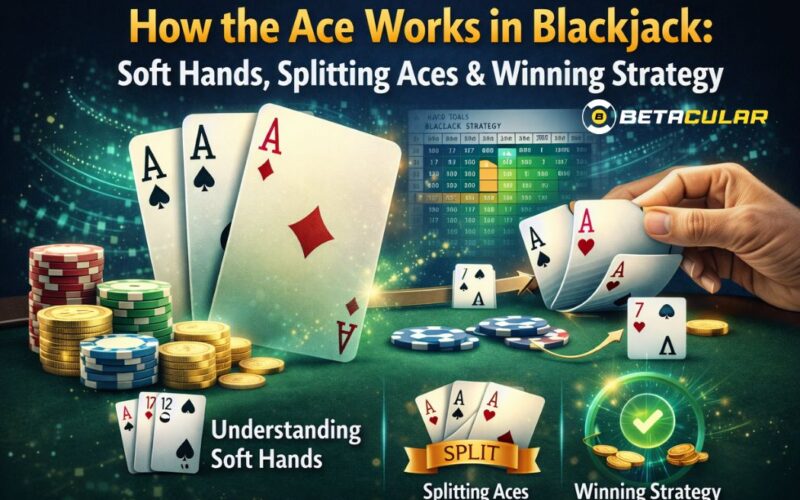
The Power of the Ace: Why It’s a Game-Changer
In the world of Blackjack strategy, no card carries more weight than the Ace. Its unique ability to “shape-shift” between a value of 1 or 11 provides players with a strategic safety net that no other card can offer. Whether you are playing at a high-stakes table in Goa or a live dealer game on Betacular, understanding the Ace is the difference between a “ploppie” (amateur) and a pro.
Because the Ace can change value mid-hand to prevent you from busting, it creates two distinct categories of hands: Soft Hands and Hard Hands. Mastering these is the foundation of reducing the house edge to as low as 0.5%.
🃏 Soft Hands vs. Hard Hands Explained
A “Soft Hand” is any hand that contains an Ace being valued as 11. It is called “soft” because it is flexible; you cannot bust by taking one additional card. If you draw a card that pushes your total over 21, the Ace simply reverts to a value of 1.
The Soft Hand Safety Net
-
Example (Soft 17): You hold an Ace and a 6. If you hit and draw a 10, your total doesn’t become 27 (bust). Instead, the Ace converts to 1, giving you a Hard 17.
-
Example (Soft 13): You hold Ace and 2. If you hit and get a Jack, your total becomes 13 (Hard 13).
Hard Hands
A “Hard Hand” is a hand that either contains no Ace or contains an Ace that must count as 1 to avoid a bust. These hands are rigid and carry a much higher risk of busting on a single hit.
✂️ The Golden Rule: Why You Should Always Split Aces
When you are dealt a pair of Aces, your starting total is either a weak 2 or a “Soft 12”. Standing on 12 is a losing move, and hitting a 12 is risky. The solution? Always Split Aces.
The Math of the Split
Splitting Aces allows you to turn one poor hand into two potentially elite hands.
-
Chance of hitting 21 on at least one hand: ~43%
-
Chance of hitting 21 on both hands: ~9.5%
The “One-Card” Rule
Be aware of standard casino rules: when you split Aces, most casinos will only allow you to draw one additional card for each Ace. If you draw a 10-value card on a split Ace, it counts as 21, but it is typically paid out at 1:1 rather than the 3:2 bonus for a “Natural” Blackjack.
📈 Winning Strategy for Soft Hands
Because you cannot bust on the first hit of a soft hand, basic strategy encourages much more aggressive play, including Doubling Down.
| Your Soft Hand | Dealer Upcard | Optimal Action |
| Soft 13–16 | 4, 5, or 6 | Double Down |
| Soft 13–16 | Any other card | Hit |
| Soft 17 | 3 through 6 | Double Down |
| Soft 18 | 2, 7, or 8 | Stand |
| Soft 18 | 3 through 6 | Double Down |
| Soft 19 or 20 | Any card | Always Stand |
Pro Tip: Never stand on a Soft 17. While 17 feels “safe,” it is a losing hand in the long run against most dealer positions. You must hit or double to improve your score while you have the Ace’s protection.
Trade Your Knowledge on Betacular
Blackjack is a game of calculated victories, and the Ace is your most powerful tool. Whether you are using the [Double Bet] feature or applying [Blackjack Odds Analysis], discipline is key.
-
Live Dealer Action: Observe real-time deck penetration with our [Integrated Live Streaming].
-
Fast Bankroll Management: Move your winnings instantly using [Modern Payment Solutions like UPI and USDT].
-
Stay Safe: Use our [Responsible Gaming] tools to set session limits and keep your strategy on track.
The deck is ready. The Aces are waiting. Are you?