
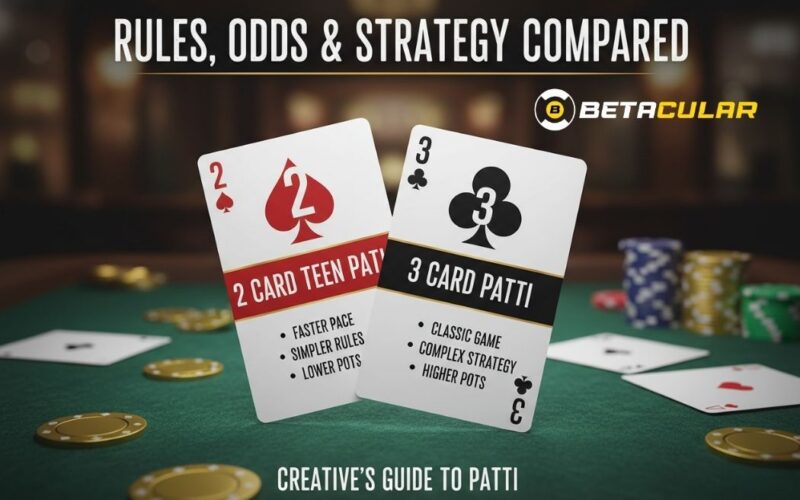
The Core Difference: How One Card Changes Everything
Teen Patti (meaning “three cards”) is India’s most popular card game, often likened to a three-card version of Poker. The traditional version involves three cards being dealt to each player.
However, the advent of online casino games has introduced many popular variations, including the faster, higher-variance 2 Card Teen Patti. The removal of just one card fundamentally changes the hand ranking probability, betting structure, and necessary strategy.
Rules and Hand Rankings Compared
While the core betting mechanics (Ante, Call/Chaal, Fold, Sideshow, and Showdown) remain consistent, the hand rankings for the 2 Card variant are simplified due to the reduced number of cards.
| Ranking | 3 Card Teen Patti (Traditional) | 2 Card Teen Patti (Variation) | Strategic Impact |
| Highest | Trail / Trio (Three of a Kind: A-A-A) | Pair (Two of a Kind) | Top hands are much easier to achieve, increasing variance. |
| Mid-High | Pure Sequence (Straight Flush: 4-5-6 of Hearts) | High Card (Any two cards) | The ‘Sequence’ or ‘Flush’ categories are eliminated entirely. |
| Lowest | High Card (e.g., A-K-J of mixed suits) | Low Card | The game relies almost entirely on Pairs and High Card value. |
Traditional Hand Ranking Order (3 Card): Trail > Pure Sequence > Sequence > Color > Pair > High Card.
Odds and Volatility: The Probability Shift
The biggest impact of removing the third card is the change in hand probability and game volatility:
| Hand Type | Probability (3 Card Teen Patti) | Impact on 2 Card Game |
| Pair | ~16.94% | Much Higher: Pairs become the elite winning hand, occurring more frequently. |
| High Card | ~74.39% | The majority of hands fall into this category, making tie-breakers (decided by the next highest card) more common. |
The Volatility Factor: Since the top hand (Pair) is relatively common, and the lowest hand (High Card) is extremely common, 2 Card Teen Patti leads to more frequent high-low outcomes and shorter rounds due to increased folding. The strategic pressure to play aggressive blinds or fold weak hands is intensified.
Strategy Deep Dive: The Art of Bluffing and Control
The optimal winning strategy changes significantly based on the number of cards in your hand.
3 Card Teen Patti: The Psychological Game
The complexity of hands (Sets, Sequences, Flushes) makes Bluffing an essential component.
-
Bluff Sparingly: Use bluffing to trick opponents into folding their stronger hands, but do so sparingly to maintain credibility.
-
Play Blind: Playing ‘Blind’ (without seeing cards) is an effective strategy in the traditional game, as it forces Seen players to bet twice the amount.
-
Observe Opponents: With more betting rounds, reading opponents’ betting patterns and body language is critical for determining hand strength.
2 Card Teen Patti: The Mathematics of the Pair
The focus shifts from reading opponents to pure probability and aggression.
-
Aggression with Pairs: When you hit a Pair, you must bet aggressively immediately, as this is the strongest hand and opponents are less likely to fold due to the higher frequency of pairs.
-
Tight Folding: Due to the simple ranking, folding weak High Card hands is the most crucial strategy. Don’t chase small pots; conserve your chips (Bankroll Management) for when you have the Pair.
-
Pot Control: Unlike the 3 Card game where long bluffs are possible, in the 2 Card game, betting is quicker and more decisive. Control the pot size based on the likelihood of a pair vs. a high card tie.
Ready to master both the traditional and modern variants of Teen Patti?
Betacular offers a secure, exciting platform to test your strategy on both 2 Card and 3 Card tables.